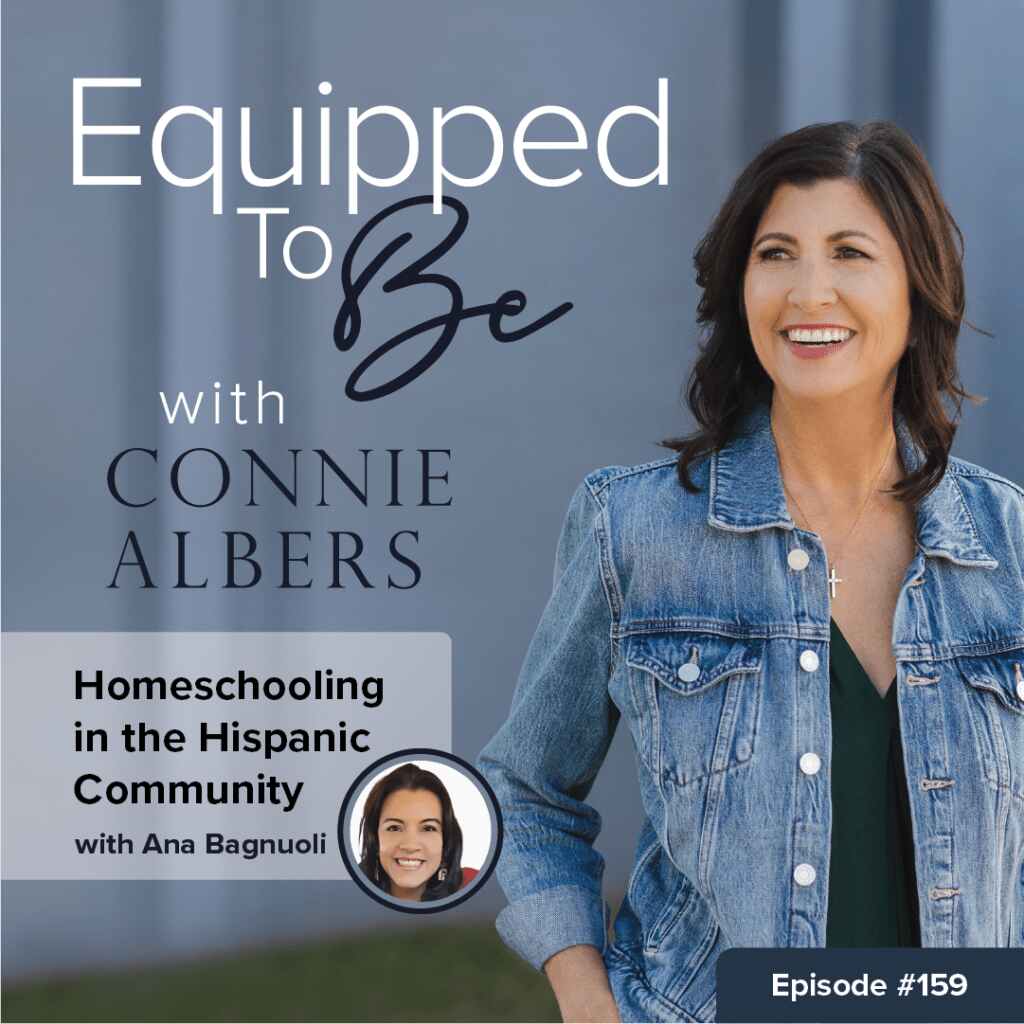
I met Ana Bagnuoli many years ago at a homeschooling conference in Florida. Together with her husband, they began serving the Hispanic community and talking about homeschooling. The ministry has grown to the point that they now have a homeschooling conference for Spanish-speaking homeschoolers. Ana has such a passion for homeschooling in the Hispanic community and I’m so excited to introduce you to her!
Shepherding a Child with Big Emotions A Biblical Approach
In this episode, Ana and I discuss:
How Ana and I met
The need for homeschooling materials in Spanish
Serving Hispanic homeschoolers in Florida
Expanding the ministry and the founding of TranistionEd
The importance of family
Starting the first homeschooling conference for Spanish-speakers
Homeschooling in the Hispanic community is growing. Share this ministry with your Spanish-speaking friends and neighbors!
About Ana Bagnuoli
Ricardo Bagnuoli born in Montevideo, Uruguay and Ana María born in Bogotá, Colombia, have been married for 14 years and are the founders of TransitionED, a non-profit organization established in the United States in 2017 that trains and equips Hispanic families on how to transform their homes in the best and first place of learning. Ana and Ricardo believe that education is a design and a tool to discover, nurture and promote God-given purpose for each child. Ana and Ricardo moved to the United States over 20 years ago and learned from scratch what homeschooling truly is. They discovered homeschooling in 2012 at a short workshop and made the decision to follow the call to become mentors and teachers to their children. They are the parents of 3 homeschoolers ages 9, 11, and 13 and they have a strong business and academic background that has helped them implement homeschooling effectively and productively in their own home. They enjoy watching other families grow, they like to cook together, read, write, do business and also camp outdoors. In 2022 Ricardo and Ana created the first Hispanic Homeschooling Conference “Educa Por Diseño” in the nation gathered hundreds of people in Miami, FL including leaders at the local, national, and international level. Ricardo and Ana have become pioneers in the Hispanic homeschooling community with more than 10 years of experience as educators, ministers, and business owners.
Ricardo and Ana María have dedicated themselves to sharing their vision as educators of their children, as entrepreneurs, and as ministers of Biblical principles for life. They are passionate about serving other families and their home is a reflection of what they live and teach others. They currently reside in the United States, Florida and are dedicated to serving the community. Ricardo and Ana María see homeschooling as a lifestyle where education unifies the family nucleus and the learning process is done as a team.
References and Links
The following may contain affiliate links.
Visit Ana’s website and learn about the conference
In the last episode, we discussed the pros and cons of sleepovers. Rather than making a blanket decision, I encouraged you to look deeper into the goals of your family and how sleepovers can fit or do not fit into those plans. This week I want to dig deeper into hosting sleepovers. What should you ask the host family? What can you do as the host home for a sleepover?
I was recently on Fox 35 Orlando to talk about the pros and cons of sleepovers. It’s hard to have an in-depth discussion on a topic like this in four minutes!
If you’ve decided that your family allows sleepovers or you handle the requests on a case-by-case basis, think about how to best talk to the host to get the information you need to make a good decision. Think about the questions and concerns that you may be asked as the host home of a sleepover.
Questions to Ask About Hosting Sleepovers
Here are some questions you can ask about sleepovers or be prepared to answer:
Who is going to be attending?
How many kids are attending?
Will the parents be there?
Are there additional guests staying with the family?
Is this an adult party for which kids were told to invite their friends?
Is this just a kids’ hangout?
The answers to these questions change the potential dynamics of the gathering. Adult parties are more likely to have alcohol accessible. A kids’ Friday night hang-out with a handful of close friends at the home of long-time family friends is going to have a different atmosphere.
What About Safety at Sleepovers?
The number one concern about sleepovers is usually about safety. This takes many faces. In my Fox 35 segment, the topic of gun safety came up. How do you handle this topic? Honestly, you just have to ask. You don’t have to interrogate the family. Just be nice and express your concern for safety without making assumptions. Try to stay neutral and not come across as judgemental. Are firearms stored in a safe and kept unloaded?
Go over these safety concerns with your kids about guns, alcohol, and drugs. Prepare them for how to respond if presented with these things and how to get ahold of you if needed. Consider having a numeric code or code word that your child can text or say when they call you to alert you to come to get them out of the situation if needed. Does your child feel mature enough to handle these situations? Are you prepared to be respectful, non-judgemental, and empathic toward your kids if you’re asked to come to get them?
Communication Surrounding Sleepovers
Communication is key in handling sleepovers!
If you have to say no to a sleepover, be honest with your kids to whatever extent your child can understand or needs to know. Be prepared to have the tough conversations with your kids if they are broken-hearted because you must tell them no they cannot attend a particular sleepover. Be sure to remind your kids that they can use you as an excuse for not being able to go to a sleepover if needed.
For our family, we chose to host sleepovers more often than attend sleepovers at another home. I knew I wouldn’t get much sleep and I’d be on the couch all night near where the kids were to monitor what was going on. I welcomed any parents to come over or call to ask questions.
Open and honest communication is the foundation you’re trying to build with your kids. Create a safe and transparent environment where your kids and their friends can express how they feel, what has happened, or what their concerns are. They need to know that they can trust you!
Pray about what is best for your kids and your family. There is no one right or wrong way to handle sleepovers!
Do you allow your kids to participate in sleepovers? I’m personally not a fan of blanket directives because each family is unique. You have to make a decision about what is best for your family based on the pros and cons of having sleepovers.
I was recently on Fox 35 Orlando to talk about the pros and cons of sleepovers. It’s hard to have an in-depth discussion on a topic like this in four minutes, so I’d like to dig in a little deeper here on the podcast with you.
Did you go to sleepovers when you were a kid? If you did, what happened at those sleepovers? There was likely a lot of talking about other people, eating sugar, and staying up all night. Maybe you did things you probably shouldn’t do along the way. Maybe your experiences make you say never to sleepovers. Maybe you had great experiences with sleepovers that you want your kids to have as well.
Pros of Sleepovers
Here are some pros of participating in sleepovers:
Social development in an unstructured, relaxed environment
Cultivation of independence in your child
Creation of defining, lasting memories and friendships
Space to learn to make good decisions and problem solve
Building trust with parents and friends
Cons of Sleepovers
What about the cons of sleepovers? There are downsides such as:
Possibility for bullying
Shattering of trust
Inappropriate behavior
Exposure to drugs and alcohol
Sleep deprivation and its results or consequences
Disruption of routines
Exclusion of some children
Is There a Middle Ground on Sleepovers for Your Family?
Before you choose to take an always-or-never stance on sleepovers, I challenge you to think outside the box and see if there’s another path that might work for your family. It’s important to know your children. It’s critical to have good communication. If you choose to allow or host sleepovers, know and communicate what you expect of your kids and those participating.
In the Albers’ family, we were generally not pro going to other homes for sleepovers. Some of this had to do with our family size and dynamics. I couldn’t have five kids running to five different places. Because my kids’ extracurricular activities, we were also often busy on the weekends making a Friday night sleepover difficult to participate in those activities the rest of the weekend. We built a life that was busy or full to meet the goals and needs of our family. Sleepovers didn’t naturally fit into that plan for us most of the time.
Here are some additional things to consider to help you decide if sleepovers are good for your family:
Why are you opposed to or hesitant to let your child attend sleepovers?
Is there a legitimate concern for your child?
Is this is a declaration that your friends have made?
Did you have a bad experience with sleepovers?
Do you know everybody who will be there?
Will the parents be home?
How many kids are expected to attend?
Is this a party or a time to hang out with close friends?
Ask your child why they want to go.
Ask questions to gauge whether your kid can stand up to peer pressure and awkward situations.
Open, honest communication is the key to all of this. Be sure to take the time to explain the responsibility and the dangers that come with sleepovers, wherever your family decides to land on the subject.
Join me in the next episode where we will dive a little deeper into the topic of hosting sleepovers!
Do you have a prodigal child? Are you desperate to guide your prodigal home? Laine Lawson Craft has lived this story with her three children. Now she’s committed to sharing their testimony and showing parents how to fight the spiritual battle to guide their prodigals back home again.
In this episode, Laine and I talk about:
How your kids are being attacked for their destiny
The number one thing that a parent (or anyone can do) for a child
What is a prodigal?
Staying in the game with your adult kids
How guiding your prodigal home is a long-term commitment
Dealing with discouragement
How to handle backsliding
How one touch of God can change everything
About Laine Lawson Craft
Laine is dauntlessly committed to guiding parents of teens and young adults to win back their prodigal children.
She partners with prodigal parents so that they find a proven battle plan and strategies to guide them to know that they are not in a war with their child but in a war with the enemy trying to destroy them; they will learn how to have authority over the battles, and how to pray for victory for their prodigal.
With over fifteen years of working with amazing people with similar hurts and spiritual warfare and guiding them to achieve remarkable success, her mission and commitment are to give you insights and revelations into how the darkness of our world operates, build your hope, and give tried-and-true tools and applications that will bring your prodigal home.
Her path to writing this life-transforming battle plan became clear after she fought hell for her children, and her family was healed and won.
Laine is an award-winning, best-selling author, popular media host, and in-demand speaker.
She has been married to Steve, her husband, for over thirty-five years, and she loves spending time with her two sons, only daughter, daughter-in-love, and son-in-love.
New York Times Bestselling author Larry Loftis is back on the show to talk about the story behind his newest novel. In this spy thriller, Larry tells the story of the life of Corrie ten Boom. Many of us are familiar with the story from The Hiding Place but that is maybe about ten percent of the story of Corrie’s life. There’s so much more to tell as Larry learned in his research. It’s a story of extraordinary forgiveness.
Larry and I talk about
Why and how Larry chose Corrie ten Boom as the main character for this spy thriller
The research went into Corrie’s life that went into this book
The role of Corrie’s father in her life
Corrie’s extraordinary forgiveness towards those who seem unforgivable
Will Larry’s books be made into movies?
How Larry’s books portray remarkable women
and more!
Be sure to pick up a copy of The Watchmaker’s Daughter and share it with your family!
About Larry Loftis
Larry Loftis is the New York Times, Wall Street Journal, USA Today, and international bestselling author of the nonfiction spy thrillers THE PRINCESS SPY: The True Story of World War II Spy Aline Griffith, Countess of Romanones; CODE NAME: LISE: The True Story of the Woman Who Became WWII’s Most Highly Decorated Spy; and INTO THE LION’S MOUTH: The True Story of Dusko Popov—World War II Spy, Patriot, and the Real-Life Inspiration for James Bond. His fourth book, THE WATCHMAKER’S DAUGHTER: The True Story of World War II Heroine Corrie ten Boom, will be released by HarperCollins on March 7, 2023.
A two-time winner of the Florida Book Award, his books have been translated into numerous languages and can be found in Spain, Portugal, Netherlands, Italy, Serbia, Czech Republic, Taiwan, India, Australia, New Zealand, and throughout the UK.
Before becoming a full-time writer, Larry was an AV-rated corporate attorney and adjunct professor of law. His academic legal works have been published in the National Law Journal, Florida Bar Journal, and the law reviews of the University of Florida, University of Georgia, and Suffolk University. He received his undergraduate and law degrees from the University of Florida, where he served on the Law Review as the Senior Executive Editor and Senior Articles Editor.
I want to take a moment to talk about God’s faithfulness. The Equipped To Be Podcast has reached a major milestone. With this episode and the transition to Season 3, we have marked three years of episodes! There were ups and downs along the way, but I’m so excited to have shared this journey with you!
The Equipped To Be Podcast launched in February 2020 right before the world was turned upside down by the pandemic. I couldn’t have done this without the team who works with me to get these episodes out to you each week. We wouldn’t still be on the air without you, the listeners, or our partners and sponsors. It’s such a testament to God’s faithfulness.
Equipped To Be isn’t just about one topic. We talk about things spanning the spectrum from parenting to education to faith and so much more because it’s all about helping you know and understand that you’re equipped to be a doer of God’s word. You have a calling and a purpose.
Many thanks also go to the guests who’ve been on the show. (See a list of some notable episodes below.) I also owe a shout-out to Libsyn, my host, who supported me and gave me guidance along the way.
This podcast started because Amanda Pelser from The Pelsers Media was sitting in my office and talking about starting the podcast. I didn’t have the technical skills to pull this off, but Amanda said she’d help me. She and her husband, Josh, have been with me from the beginning of this podcast!
Many days, I would come into the studio and just pray, “Lord, what do you want me to do?” I’d script it out or make some notes and then hit record. Then Amanda would clean and polish it and deliver it to you. Every step of the way, you were in mind because we don’t want to waste your time. It’s too precious and too valuable.
When God tells you to start something, just start. Start ugly as a book from a friend of mine says in its title. Start with what you have. Do the best you can. Go and grow as God leads. This is what we’ve done with Equipped To Be. We’ve added features over time like images and show notes and we continue to add value as God gives us the tools and resources to do so.
Would you take a moment and help us out? Your support means the world to us!
Join our email list using the box below
Leave a rating and review in your favorite podcast app like Apple Podcasts, Spotify, etc
Subscribe to the Equipped To Be podcast in your favorite podcast app
Share the podcast with a friend
(Links to a few top directories are at the end of this post for you.)
I can’t tell you what’s coming next. I’ve been in a very difficult season. I’ve had to strip away many things in my life and ask the Lord what He wants me to add back in. I do know that I have some exciting guests lined up to share stories that will help you in your journey. Back in 2020, I didn’t know if we’d last more than six months, but here we are, still bringing you encouragement. Thank you for listening. This is your milestone as much as it is ours.