When I talk to teens, I hear this time and time again. Teens want to be heard, but they feel like their parents are not listening. Parents tell me that their teen doesn’t talk to them. Your teen has few true choices at this point in their life. You are choosing where they live and where they go to school. Their choices in food and clothes are likely limited by budget or other restrictions. They are desperately trying to mature from a child into an adult, but they are not going to navigate that path perfectly. Some of the tension comes because you as the parent need to work on creating your unique parenting style and figuring out how that fits with your unique child.
Parenting Styles
There are a lot of parenting styles out there. You can do a quick search online and find the big ones named and defined. I also talk about this in Parenting Beyond The Rules. Here are a few styles that you’ll likely come across:
Authoritative
Permissive
Hovering
Helicopter
Lawnmower
Sweeper
Do you fall into any of these parenting styles? How is that working in your family?
The Goal of Your Parenting Style
Relationship with your child should be the goal of your parenting style. If you feel like there’s something missing in your relationship with one or more of your kids, it might be your parenting style. You have to be in tune with each kid. What you say or how you say something to one child could crush another child. It’s all about speaking in a way that the child can hear you.
Can I Change My Parenting Style?
Yes! Your parenting style needs to change as your child grows and matures and as they learn to show respect and honor. When you pivot and make changes to your parenting style, it shows your child that you’re working together with them. Now, about half of you are likely thinking that this is no big deal. You’re the go-with-the-flow type, and making these changes may come more naturally for you. The other half of you are freaking out right now because you don’t like change. But relationships change over time, and so must your parenting style.
How Do I Change My Parenting Style?
I’m here to tell you that changing your parenting style is simple. Ok, maybe not as simple in the sense that I can lay out all of the steps for you like an instruction manual, but I can confidently tell you the starting steps.
Step One: Pray
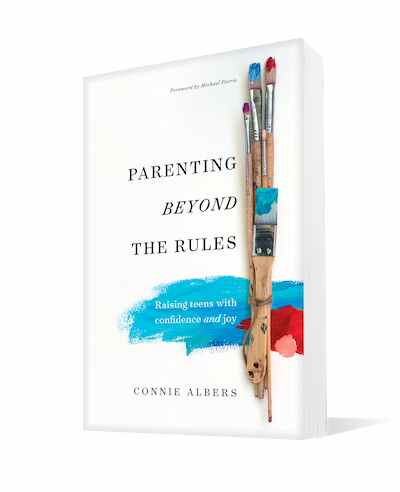
The first step is to pray. Your child, each of your children, is a masterpiece fashioned by a master creator and architect. I purposely used this imagery of paint and paintbrushes on the front cover of Parenting Beyond the Rules.
This isn’t a paint-by-number craft project. In contrast, God created your child with unique strengths, gifts, and talents. It’s your job to help your child figure out where to put the colors and shapes onto the blank canvas of their lives. When you pray, you’re talking to the master architect! Consult him about how to teach and train your child.
Step Two: See Through the Lens of Your Child
You need to work towards seeing the world the way your child does. You have to talk to them in a way that they can hear and understand you. Your strong-willed child may not flinch when you reprimand them with a harsh tone, but your sensitive child could be devasted by the same words and tone. Figure out who they are and treat them like the unique masterpieces that God created them to be. They need to know that you’re going to be there for them, no matter what happens. This is about having mutual respect and honor. To listen to each other. It’s not about winning a battle or even today’s argument. The goal is a relationship, and that means being the best parent you can be… for each of your children.
Creating Your Unique Parenting Style
Your unique parenting style will change over the years and for each child. It’s okay to change. It is necessary to change. You will have to keep creating your unique parenting style and keep adjusting it to meet the needs of your family and each of your children. Your kids are counting on you!
Have you thought about what your calling is and how you can reach it? Do you wonder about how you will get it all done? If you look at the Proverbs 31 woman and think that you’ll never measure up, I want to remind you that story is a picture of this woman’s whole life, not a snapshot of a 24-hour day! You can build the life, the credentials, and the tools needed to fulfill what God has called you to do. And you have to discipline your mind to get there.
Discipline Your Mind
When you’re struggling or find yourself in a rut, you have to intentionally discipline your mind. This is a moment-by-moment, daily exercise. It starts from the moment you open your eyes and doesn’t stop until your head hits the pillow at night. This practice will impact your day, your actions, your words, and your thoughts.
Take Hold of Your Thoughts
The saying goes something like this: As a man thinks, so is he. As much as you try, you’re not always going to be strong. There are actionable things like practicing gratitude and thankfulness that can help you take hold of your thoughts.
Be Careful What You Tell Yourself
Keep yourself from wallowing in self-pity! Don’t fall into the trap of telling yourself that you’re dumb or a loser or other things like that. You have strengths. You have God-given abilities and talents ready to be used.
Know Your Limits
It’s important to know what season of life you’re in. There are times to step out and away from something. Remember that balance is a myth. You can’t compare what you’re doing to someone else. That person is in a different season and has different gifts from you.
Clear Vision
You need to have a clear picture of what you want for your future. You can also paint a picture of the future for your children. Want to know how I did it all? I didn’t! I would step out when needed. I knew my limits. I lived my life in preparation for tomorrow. Doing what God has equipped you to do will only be possible when building these disciplines into your life. It’s time to discipline your mind!
I was reviewing some data recently for a project that will soon lead to another book. As I analyzed that data, it made me think about excellence. I pondered what it means to live a life of excellence. What are God’s standards? Excellence is important in education, in your parenting, and in your business. Whatever your task is today, excellence in that task is of utmost importance!
The Little Things Matter
Maybe you don’t think that all of the little tasks that you do in a day matter. There are little things that seem menial to us but which make a big impact on others. Maybe it’s something as simple as making breakfast for your kids each day. Simple to you, but a big deal to them. Without breakfast, they’d starve!
“And whatever you do, do it heartily, as to the Lord and not to men, knowing that from the Lord you will receive the reward of the inheritance; for you serve the Lord Christ.”
Colossians 3:23-24
Do Your Best
You have a unique assignment from the Lord. You need to run that race without falling into the trap of comparing yourself to someone else and their race. Don’t measure your best against someone else’s standard! That person has a different focus and different skills from what God has given you. Run your race to the best of your ability.
Don’t Grow Weary
It’s easy at the beginning of a new year to have big goals. Maybe you’ve chosen this weighty word to define your coming year. And then just a few weeks into the year, now you may have waxed and waned. Or maybe you are just plain tired. It’s tempting to say that good is good enough. Nope. Your best effort is what’s needed.
Leading Your Kids
When I decided to homeschool my kids, there were still some remnants of the myth going around that you couldn’t teach your own kids without a formal degree in education. Well, that’s been thoroughly debunked now. What you really need are conviction and passion. After that, you just have to do the work. Learn and figure it out along the way. But, you’re selling your kids short if you don’t teach them to strive for excellence. I’m not talking about perfection. Perfection isn’t achievable or attainable. That’s unrealistic. Excellence on the other hand is attainable because it’s about doing your best with what God has given to you.
Persevere
Sometimes life is hard. Caregiving for an elderly family member. Living with a difficult diagnosis or illness. Dealing with a wayward child. You have to get up each day and do the best you can. Tomorrow might be different. You might be able to do more or you might have to do less. Either way, you’re going to do your best. Rinse, repeat. Do your best again. The results of this perseverance are hard to see when you’re in the messy middle. I can look back now and see how things that were started years ago have turned into something put together by God. Press on, doing your best.
“What God calls you to, he’s going to equip you for it.”
Connie Albers
Stop Making Excuses
Your goal in life is to be able to stand before the Lord and have him say, “Well done good and faithful servant.” Your life does not need to be a hot mess. Sure, life is messy, but you don’t have to be a hot mess! No one can know it all or be it all. Run your race in your lane. There are reasons and there are excuses for not doing your best. Are you making excuses? Are you afraid to fail? Afraid to succeed? Take some time to examine the reasons why you make excuses for not doing your best.
Living with Excellence
You can do what God has called you to do. It is possible to live equipped. Work on gaining knowledge and skill for your tasks. Listen to the Lord’s leading. Learn when to say yes and when to say no. Be wise and discerning.
When I decided to homeschool my kids, it wasn’t because I was running away from something. No, I was actually running towards something better. I was aiming for excellence for my kids’ education. There was a lot I didn’t know, but I put in the work and showed up every day to do my best for them. This is how we should live in all areas of our lives. Strive to live a life of excellence in everything that you do!
What’s in a name? You could call it leaving a legacy or building a heritage, but are you casting a vision to your kids for what you want your family to be? Are you building a family name that has lasting meaning to your kids? What do you want your kids to say about your family after they’ve left the nest? You can start making changes now and cast that vision to your kids of who you want your family to be.
When you think of the name of Jesus, what comes to mind? Some things that come to my mind are:
Hope
Salvation
Comfort
Truth
Refuge
Guide
Provider
Protector
There’s a lot in a name!
What’s in a Family Name?
What about your family name? I thought about this a lot before we started having children. Some people now refer to this as your legacy or heritage. My husband and I wanted to break some generational dysfunction and be a witness to our extended families. What did we want the Albers name to mean? We knew our family name didn’t mean perfection. We knew we didn’t have it all together. A kid can throw you a curveball at any second and shatter that perception!
Building Your Family Name
You and your children represent your family. It’s not the way a brand would build its reputation with a tagline. Sure, maybe you’ll get labeled from time to time, but this is not about what others have to say about your family. This is about what your kids say about your family.
What does your family name mean to your children?
Have you communicated that to your kids?
When my kids were younger I’d say things like: “We are the Albers. This is how we live life. We’re honest. We don’t steal. We help people. We care for others. We serve each other. We walk with the Lord. We pray for one another. We take care of each other.”
I’d regularly made lists of these things. The beginning of a new year is a great time to think through this and make your own list. Start by writing down your family name. What are the things you want your kids to know or say about your family when they no longer live with you any longer? Think about things like:
What does your family name represent?
What does your family name represent to your kids?
Who do you stand for?
What do you stand for?
What do you believe?
What character traits do you want your family to have and display?
Who are The Albers?
I talk more about family identity in Parenting Beyond the Rules, but to help you with an example, here are the three things that were important to our family name:
We wanted our children to love the Lord and understand the difference between relationship and religion.
We wanted our kids to do life with us when they didn’t have to any longer.
We wanted our kids as siblings to know they could lean on and count on each other.
Cast the Vision
I encourage you to cast a vision of what your family is and stands for to your kids. Talk about it often. Let your kids see where they fit in your family. They are in your family by design and not by accident. God uniquely placed them right where they are on purpose. They are valued, loved, and celebrated! Through this, you are building a family name that your children will be proud to be a part of as they grow into adulthood.
A new year always brings some kind of change that must be embraced. And there have been so many changes in these last couple of years of disruption! Maybe you’re homeschooling or distance learning now, but you weren’t last year. Maybe you’re still working from home or maybe you’re transitioning back to the office. How do you adapt to these changes? Are you holding on to the One who can help you be stable in the midst of disruptions? Are you confident in the One who can help you with embracing change?
The rules of life seem to be constantly changing. How do you adapt without losing your focus or losing your why? To thrive and not just survive in 2022, it’s time to take a look at our thinking patterns of why we do what we do. Let’s walk through how you can embrace change this year.
List the Rules
Start by listing the rules that you have in your life and that of your home and family.
Why do you work the way you do?
Why do you have the curfew set that you do?
Why do you have the rules for your household that you do?
Other rules?
What is Not Working?
Make a list of things that you are struggling with in your family:
Are you struggling with sibling squabbles?
Is there a broken relationship?
Rules and practices that aren’t working?
Something else?
What Could Change?
Allow yourself to think outside of the box to make the relationships in your home better. Think about these kinds of things:
Why do you have the rules established the way that you do?
Do you need to pivot and adjust anything because of how the world has changed?
What if you had different thinking that still fit the narrative of what your family values are?
What if you tried something different?
Could you…
Listen more
Set new boundaries
Talk more as a family
As a parent, you set a lot of the rules and habits in the family. You control the zip code you live in, the shopping day, the cleaning day, the bedtimes, etc. Your kids are often left out of these decisions. How can you involve your kids in the changes and new rules?
Challenging Times
The reality of this new year is that your faith is being challenged in the midst of this culture shift. There’s pressure for you to change how you think, feel, and behave in relationship to God’s Word. Your kids are caught up in this too.
How are you teaching and protecting your kids in the midst of this change? Depending on your family and the area in which you live, your kids will have a different awareness level of what is going on in the world. Are you teaching them to be kind? Are you teaching them to be mindful of what others think or feel and how they process the world around them? Are you teaching them to be respectful without bending to the whims of what everybody else is saying or doing?
There’s a cost to standing up and being different. You have to be careful that you don’t become bitter or angry. Maybe you’ve had hard times or lost friends in standing up for your family or convictions. Remember that God is not absent. He is your refuge and gives you wisdom. You have to figure out what standing up looks like for you and your family. For some of you that will mean speaking out more. For others of you that will mean more time spent on your knees in prayer.
May God bless and lead you as you are embracing change in 2022!
Your tweens and teens have been through a lot of change. They need you to help them cope with these changes. Society at large says that they will be fine because they can handle more than their parents think they can handle, but can they? While kids are resilient, that doesn’t mean that they don’t have wounds from what happens to them. What they really need is a parent. Their parent. They need a parent who will stand up to culture and do the unpopular hard work of real parenting. How can you be the parent your child needs?
Nowadays, parents are being ganged up on by educators, government leaders, changing cultural norms, and their peers. There is a blatant attack on morals, values, and character. You are told to accept what’s happening. So basically: “Shut up, Mom and Dad. We know what’s best for your children.” Yikes!
Drinking. Casual sex. Experimental drug use. Gang activity. It’s all on the rise. But, don’t be discouraged. You can still be the parent your child needs so that they enter adulthood with strong convictions, reasoning skills, and relationships.
We can’t go back to what might seem like simpler times. Technology dominates our lives and we probably can’t reverse that. So, what can you do?
Push back!
It’s time to push back! Some of you will feel called to speak up and speak out. I know that some of you will not in the same public way. But, all of you will have to fight for your family in ways you didn’t have to before now. You have to put boundaries around you and your children. You have to decide which battles to get involved in for your family.
When the government officials and education union leaders are no longer hiding their agenda, you know they believe they are big enough to defeat you. It’s a battle of David vs Goliath. But, God is on your side!
How to Be the Best Parent for Your Child
These issues come back to who you are as a parent and what you’re willing to do. I have a few starting suggestions.
Learn About Growth and Development
Learn what you can about growth and development in adolescent children. You need to understand what they’re facing. I know you don’t have time to read every resource out there. Find a few trusted sources of information (like the Equipped To Be show!) to help you focus on what’s most important for your kids. Understanding how your children think and process the world around them will give you a greater understanding of their point of view.
Help Your Child Develop Their Identity
Help your child develop a healthy sense of self and identity. Both of these help a child learn how to become an adult. Teach them that their identity is first found in Christ. It’s also important for them to know where they belong. They have a place in your family.
“We are designed for and defined by our relationships.”
Connie Albers
Set Limits. Teach Manners and Morals.
Be an assertive parent by setting limits and by teaching your children manners and morals. Don’t be surprised when your children get angry and protest the limits and boundaries you’ve placed for your family or lessons you’re trying to teach them. But, also, don’t allow their protesting to make you believe you’re parenting poorly! On the contrary, it’s an excellent opportunity for you to communicate your family goals and vision. And like I say in Parenting Beyond the Rules, it’s an opportunity for you to “paint pictures of possibilities” for your children. They will ultimately appreciate knowing that you care about them even if they don’t show that gratitude right now.
“Your children are a masterpiece! … They’re a masterpiece and every masterpiece is unique. You do not use the same color scheme. You do not use the same brush strokes. It’s unique. Your child is unique and God has called you to help create the masterpiece.”
Connie Albers
Focus on the Why
When you can tell your children the why behind your instruction and why they might not like it initially, they will come to respect you for being willing to be the parent. Don’t make it about a set of rules but instead focus on the principle behind the rules. Don’t be afraid to adjust if you learn new information you would like to consider and implement. That is part of your children learning what it takes to be an adult. It’s a process.
Focus on the Goal
Now that my children are grown, it seems like the years of teaching and training were just a short season in my life. When things get tense in your home, try to remind yourself the season of parenting littles, tweens, or teens, is but a few years. This type of thinking helped me stay focused when tension and stress entered our home. Interestingly, I actually find that I am just as involved in the lives of my children now as adults as I was when they were kids.
Parenting tweens and teens is a comparatively short season in your life. Be the parent your child needs. Don’t be afraid to be the parent that God has asked you to be. If you know the Lord, the One who created your child, then you have what you need to raise that child!
“Parenting is an opportunity for you to paint pictures of possibilities for your child and for your family.”