You know that your kids are watching you, right? They are watching and learning from you how to communicate from the time they are little and well past the teen years into young adulthood.
Last week we finished up the series Knowing Your Strengths. We spent four episodes talking about what strengths are, how to discover your strengths, understanding your strengths, and how to use your strengths. You can listen to that conversation in episodes 71, 73, 73, and 74. That series then made me think a little more about how strengths tie into my life now and a recent situation. I needed to talk with one of my daughters and we needed to be able to speak face to face, eye to eye. So I sent a text to set up the meeting.
Your Kids Are Watching You
Before I tell you the whole story, you need to know that your kids are watching you. Maybe your child is two years old and pointing at everything while listening to you play the label game. As they get older they are watching how you handle the difficult situations and how you treat people. They pick up on even the little inconsistencies in your life. Your teens then think that what you allow for yourself is also ok for them.
The key observation here is that the words you choose are critical. How are your words going into the ears of the listener? Knowing your strengths helps you figure out how to navigate these circumstances. They are tools that give you the ability to communicate better.
See, I know my daughter and how she is best communicated with. I sent a text asking to get together to do something active and have a talk. I needed to have this conversation with my daughter. It was a hard conversation about heart issues. My heart issues!
Say It Like It Is… Or Not?
Maybe you think: I just say it like it is. In the mind, out the mouth. Well, that’s not always wise. We need to have some filters on our mouths. Some people need to warm up to what we have to say. Some people like to get right to the heart of the matter without all the chit-chat. You need to know which kind of person you’re talking to.
Would my words draw conversation out of her or put up a wall? Inflection, tone, and directness all play into how the conversation could go. In the end, the conversation with my daughter was great, but that was because I was aware of the words I was using.
Shore Up the Relationship with Your Teen
If you have a teen, now is the perfect time to shore up your relationship with them. The dynamics and influence you have will change as they grow up and move out into the world. Set the foundation now! Your kids are watching how you respond to the daily challenges of your life. How do you handle conflict? How do you handle disruptions? Will your teen choose to model what they see in you? Will they invite you into their lives as young adults?
In our conversation, my daughter made the observation that I always need to be productive. That’s one of the strengths that I have in the striving domain. I am very productive. I don’t sit well and do nothing. She said to me that sometimes she just needed me to sit and be present with her. That hit me hard. She was watching. She picked up on a place in my life that I still wrestle with.
Productive But Present
A few things to ponder:
It’s ok to be productive, but you have to be present.
It’s ok to be out leading a group or a business, but you have to make sure you’re present for your kids.
Make sure that you’re spending time in your purpose. Is this thing you’re doing the purpose to which God has called you?
Be mindful.
Watch your body language.
Are you responding with kindness, love, and unconditionality?
Are you encouraging others?
Every day brings new challenges and opportunities. As your children grow, so do you. Things are always changing and you may feel like you’re running out of time. My conversation with my daughter showed me the fruit of all of the all work and prayers I put in over the years.
In your productivity, stay present and actively engaged. Take time to speak in a way that your spouse, your kids, your coworkers, and others can hear.
Why does knowing your strengths, talents, and the domain order matter?
If you missed episodes #71,#72, or #73, go back and listen to those first before jumping into this episode.
Here are three reasons why you should utilize the Talent Theme Domains.
It gives an individual another way to think about their talents. If you know the underlying motivation, you can communicate more effectively. We can better understand why we do what we do. Believing God has given you and others unique talents, gifts, and strengths allows you to use words and phrases intentionally.
It gives an individual more confidence in mitigating their weaknesses. Rather than focusing on their bottom Talent Theme, the individual can look at the Talent Themein the same domain that is highest in their sequence and determine how to use that talent to achieve the result the results they are looking for. You gain more confidence when you learn how to manage your weaknesses regarding Talents. Now, I want to remind you there are no bad strengths. One strength is no better than another. The purpose is to see what is good and right about you. I’m just going to repeat this. I think I’ve said it in every episode. But it needs to be repeated because we tend to see what’s wrong with us and others, which causes anxiety and strife. The purpose of this series is that I want to help you know what is good and right about you. God formed and fashioned you; he made you exactly as he wanted you to be. Should you work on areas of your life? We do because we need to; we’re not perfect. We are in the process of being polished and refined, and that takes intentionality.
It gives you a way to look for gaps and learn how you speak to others to get people moving in a specific direction. For example, to get your children to do what you’re asking them to do or get them to talk about something important to them. If you learn how to utilize the Talent Theme Domain buckets, you can motivate your children or even yourself to move towards that goal.
Invite your friends to tune in. You should also go back and listen to the first three parts of the Strengths series on Knowing Your Strengths. I hope and pray that this is a huge blessing to you and helps communicate with your children, spouse, friends, co-workers, and ministry leaders better. It’s just so important to learn to pause for a moment and think about how others will hear what you say.
If you’re a note-taker, press pause for a second. I want you to write something down: It’s not about what you say. It’s about what someone else hears that matters.
For example, you can communicate a request thinking others know the intent behind your words, but it comes off as a command to the hearer. On the other hand, not thinking first can cause a simple request to fold the laundry to come across as an abrupt or demanding void of empathy or compassion.We want others to hear our words to land in a tender place of someone’s heart. So we can’t be harsh or reckless with our words.
Focusing on your Talent Themes and where they place in the order of dominance can make a huge difference in your relationships.The Gallup Organization puts talents into four domains: The Relating Theme, Impacting Theme, Striving (Executive) Theme, and Thinking Theme.
We can use the knowledge of Talents to identify negative labels as clues to a talent. In addition, learning to use negative labels as clues can positively benefit those we love.
Four Talent Theme Domains
Relating Talents—used to create, develop, and sustain relationships effectively. Prompt how a person reaches out to others and responds to those who reach out to them.
Adaptability
Developer
Connectedness
Empathy
Harmony
Includer
Individualization
Positivity
Relator
Influencing Talents—contained in themes used to motivate others to action. Prompts a person to set a course for individuals and groups to follow and then get them moving along that course. Stimulate others to be more productive, reach for excellence, and fulfill personal potential.
Activator
Command
Communication
Competition
Maximizer
Self-Assurance
Significance
Woo
Striving Talents—contained in the themes used to push the self towards results motivates a person to get things done, then seek greater accomplishments. Distinctive motivations that influence individuals to do the same task differently. Striving themes are the fuel that propels people to excel, take risks, and set high expectations.
Achiever
Arranger
Belief
Consistency
Deliberative
Discipline
Focus
Responsibility
Restorative
Thinking Talents—the way people gather, process, and make decisions with information and mental images. People think in the past, present, or future. Thinking themes influence one’s view of the world, the way they treat others, interpret current events, solve problems, and create opportunities.
Analytical
Context
Futuristic
Ideations
Input
Intellection
Learner
Strategic
Words to Use When Describing Negative Labels.
Use those labels as clues to see the positive side of their characteristics:
Controlling say In-Control
Bossy use Assertive, Determined
Doormat use Flexible
Obstinate use Persistent
Anti-social use Inner-directed
Uncooperative, antagonistic use Independent thinker
Smart-aleck use Clever
Nosey use Curious
Not a team player use Self-motivated, Inner-directed
Think about the positive attributes of negative words. Our words have the power to build up or tear down. By taking the time to think before we speak, we will be heard and understood more clearly.
God uses people to accomplish his will. He expects us to engage with the world around us in an understanding way. Furthermore, we are to teach and train our children in the way they should go. Leading our children by speaking in a way they hear can have a dramatic impact on your relationship.
God has uniquely wired people to complete their assignments.
Thank you for tuning in. We would love for you to leave a review. Unfortunately, I forget to ask you to leave a review regularly or to hit the subscribe button in your favorite podcast app so it pops up in your feed so that you can listen every Wednesday at 8:00 AM Eastern.
*Note: if you purchase one of the books with a code, you do not need to buy an additional code from Gallup. But, don’t buy a used one. The chances are that code has already been used.
**If you have a tween or younger teen, I recommend that they take Strengths Explorer. It is geared for kids ages 10-14.
Knowing your strengths and your child’s strengths can bring great clarity to you and your child so that everyone can see the masterpiece God designed them to be. While many personality assessments are available, few have the research behind them that StrengthsFinder does. That is based on the work of Donald O. Clifton. The researchers at the Gallup Organization have spent over five decades developing CliftonStrengths. If you missed episodes #71 and #72, go back and listen to them. I explain strengths in greater detail.
Now, back to knowing your strengths. You must first understand that all of the 34 talents are good. That’s right! There are no bad ones. Certain strengths aren’t better than others, so dispel that thought now. My goal as a Strengths Practitioner is to help you come to a place of peace, knowing God made you who you are and reminding you that you can’t be excellent at everything! I know many people want to be excellent at everything, but the truth is you can excel at a few things. It’s essential to understand that from the get-go.
It would help if you stopped trying to do it all and discover what you are exceptional at doing. Once you fully grasp how intentional God was in designing you, you will wrestle less with wishing you were like someone else and live with greater internal peace. But, you must remember, like your children, you are a masterpiece, too.
For years, I’ve listened to thousands of people lament their weaknesses and glaze over their talents. They marginalize what is good and right about them or their children, focusing instead on what needs fixing. In Strengths Finder, weaknesses aren’t defined as something that needs to be fixed. Weaknesses aren’t a flaw. They are simply talents that will not become a strength, even if we add all the knowledge and skills.
Our areas of weakness are an opportunity for God to work through us. Remember, in our weakness, God’s strength is made known in us. Weakness also allows others to use their talent to help us complete a project we would otherwise struggle with if we were on our own.
Jesus appointed twelve apostles who were different. Why were they so different? Jesus uses ordinary people living everyday lives to do extraordinary things. We can’t be replicas of each other. We are made in His image. You are a custom design—a unique original masterpiece.
You are custom-crafted, tailor-made! That is a beautiful picture of you!
Understanding Your Strengths
Pay attention to the following:
What do you and others say?
What do you and others do?
How do you and others engage in the world?
Write these down. When you get intentional about learning, you will begin to see a pattern.
Don’t discard the little things. Pay attention! By becoming aware of the little things, you will increase your understanding of yourself and others.
Listen for exact phrases. Those are a peek into the person.
Many have asked if it is possible to turn a talent into a strength by adding knowledge and skills. Yes! That is what one does to develop a talent.
You can’t teach talent, but you can develop them. The way to develop talent is to add knowledge and skill. Once knowledge and skill are acquired, a talent becomes a genuine strength.
Avoid believing false assumptions, such as that you can do anything if you work hard enough. While we can improve our weaknesses some, learning to develop the God-given talent within you will have the most significant impact on the Kingdom.
*Note: if you purchase one of the books with a code, you do not need to buy an additional code from Gallup. But, don’t buy a used one. The chances are that the code has already been used.
**If you have a tween or younger teen, I recommend that they take Strengths Explorer. It is geared for kids ages 10-14.
Do you know your strengths? Have you spent time trying to discover what you are uniquely designed for? Do you know why you do what you do? Do you know why you think, feel, and behave in a certain way?
In this episode, I will go deeper into the world of strengths and how knowing your strengths can help you understand yourself and others with great clarity.
The purpose of learning about strengths is not to impress others with your knowledge but to help you communicate with your family and others in a richer, deeper way. People are desperate to be seen and heard. It is a core need God placed within every person. Therefore, if you know how to speak to others in the way that they hear, imagine how much better your relationships
will be.
If you can learn the language of Strengths, you will gain insights into how others think, feel and process the world around them. You can learn to see through the lens of others. As a result, your understanding of others is improved.
Transformation happens in three ways:
10% formal learning
20% classes, webinars, and group projects
70% experiential learning
May I encourage you to remember how real transformation happens so that you don’t waste precious time and maximize your efforts?
Start the Strengths Discovery Process
How do you start the process of discovery?
Start a journal and write down what you say and what your kids say.
Listen to the words you and others.
Stay in your lane. You can’t live someone else’s life.
Print your report and read it. Highlight what stands out to you.
Pray. Ask the Lord to help you understand.
Think about the results. Do you agree with your report?
Understand how to develop your talent into a strength. You add knowledge + skill. You must learn and practice so that your talent grows. Over time, your diligence results in greater proficiency in being the person God made you.
When you put forth the effort to learn about yourself and others, how you engage in the world around you changes.
I want you to learn how to excel and soar using your gifts, strengths, and talents, doing what God has called you to do.
Over the next few podcasts, I’ll take you deeper and explain how to apply this information to your life.
Stay tuned, invite your friends, and join us next time as we discuss Strengths.
*Note: if you purchase one of the books with a code, you do not need to buy an additional code from Gallup. But, don’t buy a used one. The chances are that the code has already been used.
**If you have a tween or younger teen, I recommend that they take Strengths Explorer. It is geared for kids ages 10-14.
Do you know your strengths? Are you like most people who spend a good deal of time trying to strengthen your weaknesses? Do you dwell on what you aren’t particularly good at doing?
Chances are you do. Most people do.
While that might make you feel better knowing other people struggle the way you do, that will not help you in the long run. It can’t! Not if you want to become the person God created you to be and run the race with excellence.
Dwelling on weaknesses is counterproductive. What’s the alternative?
Know your strengths and learn how to develop them properly so you will gain more confidence in engaging with the world around you.
I’ve been interested in knowing how others think, feel, and behave for decades. My interest in understanding people better began in high school. I listened to how my friends talked about their lives. I paid attention to what they struggled with, what they delighted in doing, and how they handled problems. Some did quite well, while others failed miserably. It got me thinking about coming up with a solution. How could I help people understand themselves better?
To help others, you must gain knowledge. So I did. I started reading and taking classes. I wanted to help my friends.
A few years ago, I decided to go deeper, so I hired a personal Gallop coach to teach me more. It was an intense time of learning and reading, but it was worth it. I became a master coach. I now call myself a “Strengths Practitioner.” And I love helping parents, professionals, couples, teens, and college students understand how God made them. I especially love the moments when it all comes together for them. Wow!
What if I told you there is a way to know how God formed and fashioned you? Well, there is. In this episode, we’ll discuss CliftonStrengths and the Strengths Assessment by the Gallup organization.
I’ve decided to make this into a series. Today, I’ll give a brief overview of strengths:
What is Strengths
Who is Donald O. Clifton
How long has this been around
Is this a feel-good personality assessment or research-based, data-driven?
How do you take the assessment?
How many questions?
Over the next few podcasts, I’ll take you deeper and explain how to apply this information to your life.
Stay tuned, invite your friends, and join us next time as we discuss strengths.
~Connie
*Note: if you purchase one of the books with a code, you do not need to buy an additional code from Gallup. But, don’t buy a used one. The chances are that the code has already been used.
**If you have a tween or younger teen, I recommend that they take Strengths Explorer. It is geared for kids ages 10-14.
When I began homeschooling in the early ’90s, most people didn’t know it was legal or if it was possible. Parents had a lot to prove to society, especially since professional educators had convinced parents that only qualified “teachers” were fit to educate children.
Well, we worked hard to prove that parents could educate their children thereby disproving their decades-long messaging. It was a tactic used to make parents doubt their ability to educate their children. After thirty years of shaping a movement, parents are still told they don’t have what it takes to teach their children. Something I find hard to imagine. Thankfully, millions of parents don’t buy into that argument anymore.
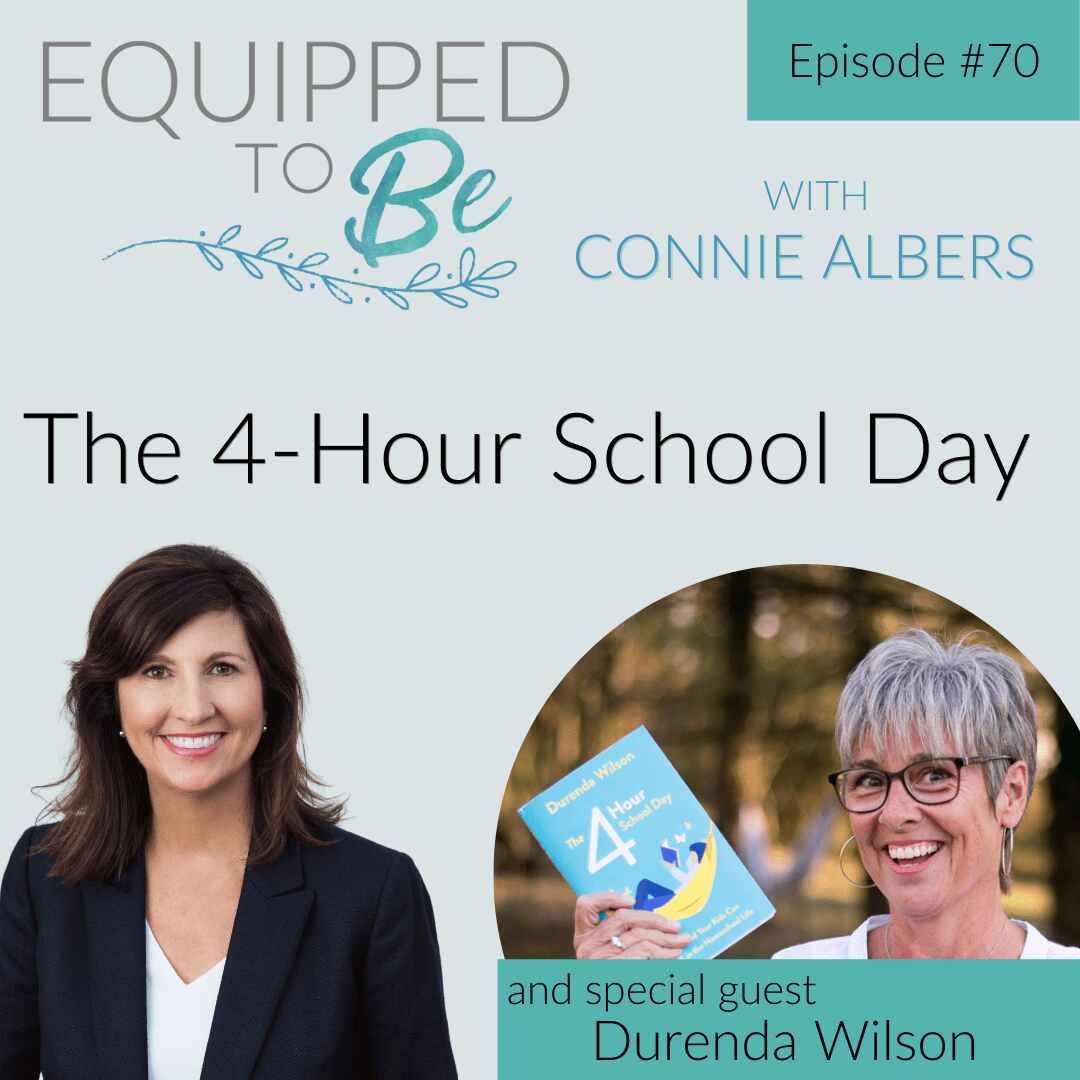
In this episode, Durenda Wilson, author of The 4-Hour School Day, shares what she has learned along the way. We debunk myths surrounding homeschooling and discuss the positive elements of children learning at home. Our goal is for you to have a positive attitude towards parenting and motherhood.
The 4-Hour School Day
You homeschooled all eight of your children; what advice do you have for parents just starting to homeschool?
You are qualified.
You can teach your child.
Don’t underestimate your ability.
Ignore the naysayers.
Don’t give up on hard days.
You’re on an adventure.
Work from a place of nurturing.
What advice do you have for parents who have been teaching at home for a few years?
Choose purpose over performance. It’s easy to fall into the performance trap, but you will be more likely not to get overwhelmed or stressed out when you keep the big picture in mind.
What are the major benefits of homeschooling your kids?
Parents decide what to teach, when to teach, and how to teach their children.
Parents can customize their education in such a way that their children thrive.
You are offering a fresh perspective on homeschooling; what is the biggest myth about homeschooling you want to debunk?
It doesn’t have to take all day. Homeschooling can be done in a 4-hour school day.
Socialization v Socializing: There is a difference!
Many parents feel they are not qualified to teach their kids; is that true?
No, it’s not true. You can teach your child. You play a valuable role as a parent. *No one cares more about your child’s education than you do.
What is the number one lesson you want readers to take away from “The Four-Hour School Day?”
That providing an excellent education doesn’t have to take all day. And that your role is valuable. Your children will gain a sense of security and safety with you as their primary educator.
Remember, you can choose purpose over performance as you homeschool your child!
About Durenda Wilson
With more than twenty-five years of home education experience, Durenda Wilson is a trusted voice and resource at homeschooling conventions and on The Durenda Wilson Podcast. Durenda and her husband, Darryl, have eight kids and six grandbabies. As an author and speaker, her greatest joy is helping moms discover God’s grace—and with it the courage to put their full trust in him, moving forward in faith and confidence.