
What if some evidence about the Bible has been sitting beneath our feet for thousands of years?
Most Christians have heard challenges to the reliability of Scripture.
Did these people really exist?
Did these events actually happen?
Are some biblical accounts history, while others are simply religious stories passed down through generations?
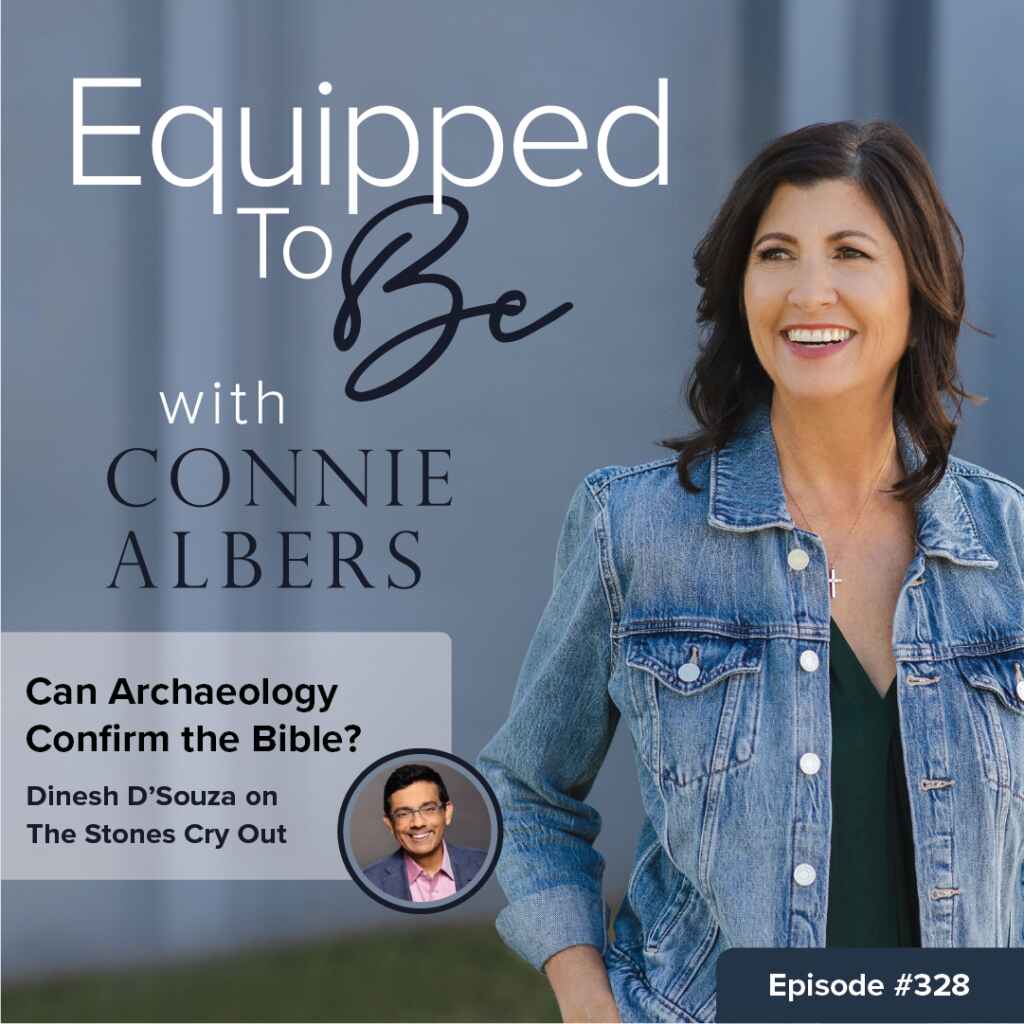
Those questions are not new. But archaeological discoveries have given us another way to examine the ancient world described in Scripture.
That is the subject of my fascinating conversation with Dinesh D’Souza about his new book, The Stones Cry Out: Biblical Archaeology, Prophecy, and the Last Days.
And what makes this conversation so interesting is that Dinesh approaches many of these questions through evidence.
Faith Does Not Require Us to Fear Questions
Sometimes Christians become uncomfortable when someone starts asking hard questions about the Bible.
I understand why.
For many of us, Scripture is deeply personal. It shapes what we believe about God, humanity, morality, eternity, and the way we are supposed to live.
Questions can feel threatening.
But truth does not become less true because someone examines it.
And faith does not require us to stop thinking.
Throughout Scripture, God repeatedly acts within real history through real people, places, rulers, nations, conflicts, journeys, and events.
Christianity is not presented as a faith detached from history.
That matters.
When Archaeology Meets the Biblical Record
Biblical archaeology allows researchers to study the physical remains of the ancient world.
Sometimes that means excavating cities mentioned in Scripture.
Sometimes it is an inscription containing a familiar name.
Sometimes it is pottery, a seal, a road, a structure, a manuscript, or the remains of a civilization that helps us better understand life thousands of years ago.
Archaeology cannot answer every spiritual or theological question.
It cannot dig up faith.
It cannot scientifically verify every miracle recorded in Scripture.
And scholars do not agree about the interpretation of every discovery.
But archaeology can help us ask whether the historical world described in Scripture corresponds with what we find in the historical record.
That is a worthy question.
The Bible Is Filled With Real Places
One thing I found especially interesting about this conversation is the reminder that Scripture happened somewhere.
These weren't characters floating around in an imaginary religious world.
There were kings and kingdoms.
Cities and roads.
Battles and governments.
Temples and marketplaces.
Empires rose and fell.
People lived, worked, traveled, worshiped, rebelled, suffered, celebrated, and died.
When we read the Bible only as a devotional book, we can flatten it unintentionally.
We forget that these events unfolded in history.
Biblical archaeology helps restore texture to the world of Scripture.
Suddenly, a place we have read about for years has geography.
A ruler has historical context.
A city has walls.
A road has stones.
And the Bible becomes less abstract.
But Evidence and Faith Are Not the Same Thing
This distinction is important.
Archaeological evidence can support historical claims. It can help illuminate Scripture and sometimes challenge previous assumptions.
But Christianity ultimately makes claims archaeology cannot test with a shovel.
That God exists.
That Jesus Christ is the Son of God.
That Christ died for our sins and rose again.
That salvation comes through Him.
Those are not conclusions we reach merely because someone found an artifact.
Faith is more than archaeology.
But that does not make historical evidence unimportant.
In fact, Christianity makes remarkably strong historical claims.
The Gospel writers name rulers, cities, regions, customs, religious leaders, and events.
Luke even begins his Gospel by explaining that he carefully investigated what had happened so that his reader could have certainty about what he had been taught.
Christian faith has never required intellectual carelessness.
What About Prophecy?
This is where Dinesh takes the discussion a step further.
His book is not simply about what archaeology might tell us about the past. He connects biblical history with biblical prophecy and asks what the reliability of Scripture's historical record means for the way we consider its claims about the future.
That is a much larger discussion.
Christians should approach it with humility, discernment, and careful study of Scripture.
Prophecy has unfortunately become an area where speculation can easily overshadow wisdom.
Our goal should not be to chase sensational predictions.
It should be to know God's Word well enough that we are steady, discerning, and faithful regardless of what is happening around us.
Why This Conversation Matters Now
We live in a culture that does not simply question Christianity.
It questions whether truth itself can be known.
That presents Christians with an important responsibility.
We should know why we believe what we believe.
We should be able to distinguish between faith and wishful thinking.
We should not be frightened by sincere questions.
And we should teach our children that Christianity does not require them to turn off their minds in order to follow Christ.
Our children are going to encounter skepticism.
They will hear people question Scripture.
They will encounter confident voices telling them that Christianity has been disproven, that the Bible is mythology, or that faith and reason cannot coexist.
Telling them, “Just believe,” is not enough preparation.
We need to help them develop a faith that is rooted, thoughtful, tested, and able to withstand questions.
That does not mean we will have an answer for everything.
We won't.
But we can teach them not to be afraid of searching for truth.
Because if something is true, examination does not destroy it.
The Stones Still Have Something to Say
That's ultimately why I wanted to have this conversation.
Not because an archaeological discovery replaces Scripture.
Not because every debate has suddenly been settled.
And certainly not because Christians need an artifact before they can trust God.
But because the Bible unfolds within history.
And sometimes something buried for centuries gives us another glimpse into that history.
A name.
A city.
An inscription.
A road.
A wall.
A stone.
And suddenly words we have read many times are connected to something remarkably tangible.
Listen to my full conversation with Dinesh D’Souza on Equipped To Be as we discuss The Stones Cry Out, biblical archaeology, evidence, prophecy, and why examining the historical world of Scripture can deepen the way we understand our faith.
About, References, Bio, and Links
Dinesh D’Souza is an Indian-American author, filmmaker, and political commentator. Across forty-plus years of public life he has written 19 books, directed 8 feature documentaries, and built one of the most-watched shows in American politics.
The following may contain affiliate links.
- The Stones Cry Out by Dinesh D'Souza
- Learn more about Parenting Beyond the Rules


